I had the pleasure of being interviewed on eitb.es a few days ago, I hope you like it
You can listen to the interview here
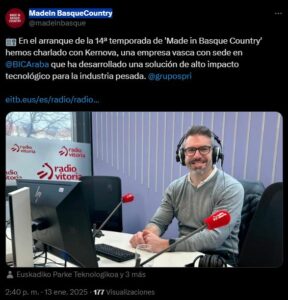
Oliver Bieito is an industrial technical engineer and co-founder of Kernova, a recently created SME based at the BIC Araba of the Álava Technology Park, which has developed a technological solution for heavy industry that saves up to 35% of electricity in industrial machines. This solution puts this Álava firm at the forefront of sustainable engineering, with advantages that improve energy efficiency and reduce environmental impact. He explained all of this on the programme ‘Made in Basque Country’, which in 2025 is in its 14th season.
Other Made in Basque Country interviews and posts on their X account:
Here is the transcript of the highlights:
As every Monday at this time, we have a new appointment with innovative companies. Today, we present the first company of 2025 in this section, Kernova, located in the Bahía Technology Park in Vícar, Almería. This company has managed to cut electricity consumption in industrial machines by up to 35% thanks to a revolutionary electromechanical solution that they have developed. With us is Oliver Díaz Rivera. Good morning, Oliver.
Oliver: Good morning, thank you very much for the invitation. It is a pleasure to be here.
Interviewer: Is this your first radio interview?
Oliver: Yes, that’s right. Although I have given many talks and taken part in presentations, this is my first experience in front of a microphone. I hope it is the first of many.
Interviewer: I’m sure it will be. Let’s talk about Kernova, a young company born with the aim of developing more efficient and sustainable industrial machinery. How did this idea come about?
Oliver: Kernova was born with the commitment to create sustainable, highly efficient machines. Our patented solution exceeds current market standards and, in addition, we have a talented team that lets us develop projects at an international level. We focus on the electrification of industrial processes, eliminating the losses associated with traditional mechanical systems, which makes us 30-35% more efficient.
Interviewer: What type of machinery do you apply this technology to?
Oliver: Our technology is designed for machines that need to move large loads at medium and high speeds. We replace traditional mechanical systems with electromechanical solutions that combine the best of both worlds: simple mechanics with the efficiency of electricity. We have already achieved forces of up to 300 tonnes, which shows that our technology is ready for heavy industrial applications.
Interviewer: So you already have commercial applications?
Oliver: Yes, our solutions are on the market and we have planned to build a prototype for 2025 that reaches a medium-high range in terms of load capacities. This will let us consolidate our product and go to market with an advanced, proven technology.
Interviewer: Is there a specific sector you are focused on?
Oliver: We work mainly in industrial recycling and heavy machinery. We are also developing solutions for skyscraper maintenance, collaborating with a company that manufactures custom equipment for cleaning and maintaining facades. Each machine is designed to measure for the building’s needs.
Interviewer: How is the design and construction of those machines managed?
Oliver: These machines are assembled like a Meccano set to make them easier to transport and install on buildings. It is a challenge because working at great heights in adverse conditions requires a very precise and safe design.
Interviewer: Changing the subject, is this your first experience as entrepreneurs?
Oliver: Yes, it is the first time we have undertaken a project together. We met while working for other companies, and seeing that our skills were complementary, we decided to take the step. My partner is an expert in simulation and industrial manufacturing, which has been key to moving Kernova forward.
Interviewer: How have you handled remote work?
Oliver: We work with engineers in different countries, such as London. Kernova’s philosophy is that talent has no borders. Thanks to technology, we have been able to collaborate remotely without problems.
Interviewer: What are your expectations for 2025?
Oliver: This year we expect to build our prototype and keep developing automated logistics solutions for well-known companies in the industrial sector. We have important challenges, but the support we have received from programmes such as Fast Track has been fundamental.
Interviewer: Thank you very much for sharing your experience. We wish you a great deal of success on this path.
Oliver: Thank you for the invitation. It is a pleasure to share what we do.